Solar Charge Controller: 2021 Top 10 Review
- Lee Stauss
- Power
- 31 Jul, 2021
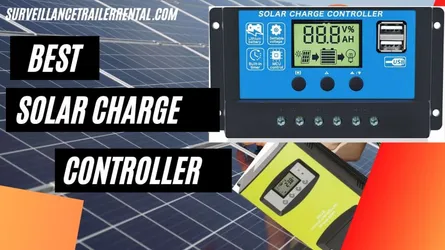
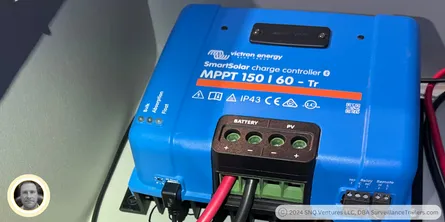
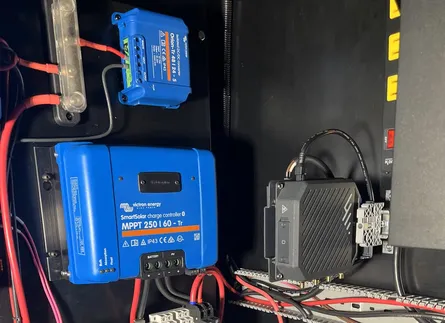
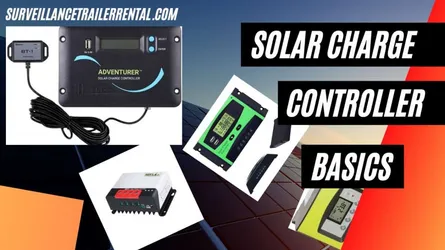
A solar charge controller device is vital to avoid damage to your battery. It ensures that energy flows are safe from damage and precisely managed by acting as an intermediary between the source of energy, solar panels, and your final load.
When deciding on the choice of solar charge controller, it is essential to make comparisons between different types to know which one is best for you. The following list of the top solar charge controllers in 2021 is aimed at guiding you in selecting the ideal option that suits your needs.
Charge controllers are usually available in a range of prices and features and are mostly renowned for their power capabilities and simple design.
Are you short on time? Check out our Top Rated Products from various categories:
The Best Solar Charge Controllers
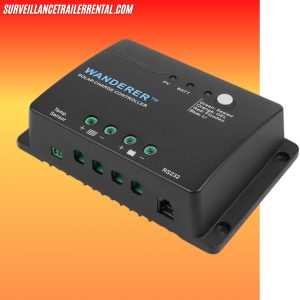
Renogy Wanderer Solar Charge Controller
[mks_col] [mks_one_third]
Renogy Wanderer Solar controller
[/mks_one_third] [mks_two_thirds]
Key Features:
- Preprogrammed parameters that are based on the battery type.
- Four-stage charging process for PWM.
- Maximum input PV voltage 50Vdc.
Specifications
- RS232 port for communication with Bluetooth T-1 module.
- Two USB 5V, 2 amps ports.
- Battery Voltage 12/24V.
[/mks_two_thirds] [/mks_col]
It is suitable for charging 12 or 24-volt battery banks with a charging capacity of 10 amps and is ideal to be used in conjunction with portable solar panels.
The controller is equipped with electronic protection functions like self-diagnostics, overcharging, reverse current reverse polarity, and self-diagnostics. So, this helps to prevent damages caused by system faults or installation errors.
The PWM algorithm utilizes a 4-stage charging process to ensure safe, quick, efficient, and effective battery charging. They include the Bulk charge, Boost, Float, and Equalization charge.
Although the AGM and flooded batteries are equalized every 28 days, the equalization intentionally overcharges the battery for a controlled period. In addition, regularly equalizing will improve the performance of the batteries.
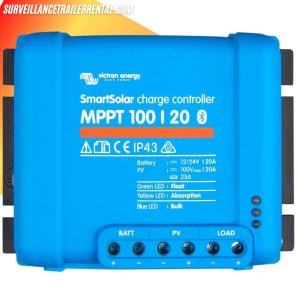
Victron SmartSolar MPPT 100/20 Charge Controller
[mks_col] [mks_one_third]
Victron SmartSolar MPPT 100/20 Charge Controller
[/mks_one_third] [mks_two_thirds]
Key Features
- Victron Remote Management Portal.
- Complete remote configuration via smartphone possible.
- Maximum open voltage of PV input is 100Vdc.
Key Specifications
- SBuilt-in Bluetooth.
- Current charged at 20A.
- Battery Voltage 12/24V.
[/mks_two_thirds] [/mks_col]
Victron Energy, a well-known manufacturer of high-quality products based in the Netherlands, is the company behind the Victron SmartSolar MPPT 100/20 model.
This solar charge controller panel is an excellent choice for those who are new to solar system installation. It is a smart and lightning-fast design.
The major attraction feature; the wireless Bluetooth management system, places this device at the top of the list. It allows remote monitoring and setting updates through smartphones or Victron products. The MPPT control is configured to allow a three-step charging process to extend the life of the batteries. However, it can also be programmed to equalize lead batteries.
It is user-friendly because the built-in LED indicator lights offer an instant view of the charging stage of the battery. This allows you to diagnose faulty system situations with the combination of ON, OFF, and blinking status of the LEDs.
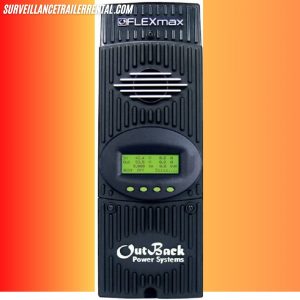
Outback Flexmax 80 Solar Charge Controller
[mks_col] [mks_one_third]
Outback FlexMax 80A Solar Charge Controller
[/mks_one_third] [mks_two_thirds]
Key Features:
- Temperature sensor for remote control.
- Voltage step-down capability allows for PV open-circuit voltage up to 150 VDC.
- Included 128 days of data logging.
Specifications
- RJ45 modular connector Cat 5 cable 8 wire to the remote interface.
- Rated Output Current 80A.
- Battery Voltage 12/24/36/48V.
[/mks_two_thirds] [/mks_col]
The Outback Flexmax 80 charge controller uses a continuous Maximum Power Point Tracking (MPPT). MPPT is an algorithm for tracking. It seeks out the maximum power from a solar array and uses it to fully recharge batteries. This allows you to harvest the most energy produced by solar panels.
In addition, Outback’s FLEXmax 80 solar power controller works at full spec features due to its intelligent refrigeration system. This allows it to work at a maximum of 80 Amps and a maximum temperature of 100 degF (40 degC). It also works with a variety of nominal voltages for batteries due to its superb step-down voltage feature. This allows for a greater solar array configuration.
The FLEXmax model comes with a backlit LCD screen that displays the system’s state. It has 80 characters. The cycle for the batteries can be set to auto-equalize or manual using the display, and, in conjunction with the communications components (MATE3) provides access to 128 days worth of operational data for review.
WindyNation P30L Charge Controller
[mks_col] [mks_one_third]
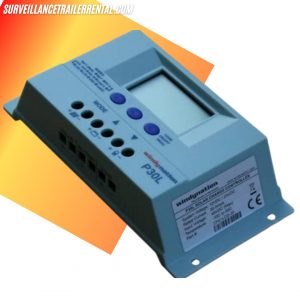
WindyNation P30L
[/mks_one_third] [mks_two_thirds]
Key Features:
- Electronic protection against short circuits, overloads, and reverse direction.
- Compatible with AGM, lead-acid, and GEL-type batteries.
- Optional temperature compensation.
Key Specifications:
- Maximum Solar Input Voltage: 50V.
- Rated Output Current 20A.
- Battery Voltage 12/24V.
[/mks_two_thirds] [/mks_col]
An automatic detect function is ideal for 12 and 24 volts batteries. It can provide the capacity of 30 amps of charge current. Circuit protection includes overload, short-circuit, reverse polarity, source lighting.
Additionally, the enclosure is made out of tough plastic and has visual LCD symbols that give indications of charge status, battery status, battery level, and system failures.
Epever MPPT Charge Controller
[mks_col] [mks_one_third]
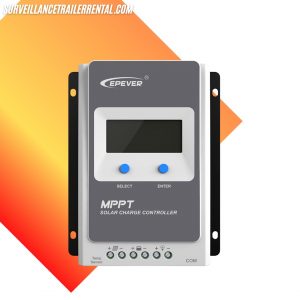
Epever MPPT Charge Controller
[/mks_one_third] [mks_two_thirds]
Key Features
- Multiple load controls.
- Remote communication using mobile apps and PC.
- The MPPT control algorithm is ultra-fast.
Key Specifications:
- RS-485 and Modbus communication bus and protocol.
- Charge current rated @ 20A.
- Battery Voltage 12/24V.
[/mks_two_thirds] [/mks_col]
The Epever MPPT Tracer AN series is an advanced MPPT algorithm-based solar charge controller. It is at the top of the list of charge controllers using MPPT. This is because of its cost-effective capabilities with a conversion efficiency of as high as 98%
This charge controller features a programmable multi-function LCD display for a variety of battery types including sealed, GEL, flooded, AGM, LiFEPO4, and NiCoMn. It also features a function that automatically recognizes the voltage of the battery.
Furthermore, its RS-485 communications bus interface and Modbus communication protocol allow mobile app or PC software parameter monitoring and setting, and it is able to meet various communication requirements for different scenarios.
The remote meter MT-50 shows real-time operational data and system faults, as well as the remote temperature sensor, which allows temperature compensation according to the battery temperature.
The Tracer 2210 AN is rated for an open-circuit input voltage of 100 volts from the panels, which allows up to 390W for 12 volt systems, and 780W on 24 volts of power input.
Multiple load modes give total control over the battery’s charge and discharge process.
Renogy Adventurer
[mks_col] [mks_one_third]
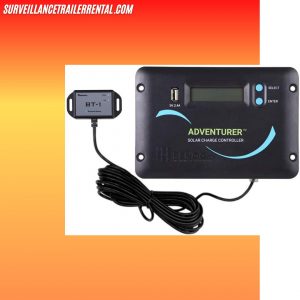
Renogy Adventurer 30A Charge Controller
[/mks_one_third] [mks_two_thirds]
Key Features
- Programmable lithium charging voltage.
- PWM 4-stage algorithm.
- Optional temperature compensation.
Key Specifications:
- RS232 Communication Port with Bluetooth.
- Charge current rated @ 30A.
- Battery Voltage 12/24V.
[/mks_two_thirds] [/mks_col]
The Adventurer-Li model manufactured by Renogy Adventurer is ideal for applications that require off-grid power on 24V and 12V systems. The 30amp model is able to charge most Lithium batteries thanks to its programable Lithium voltage.
The remote temperature sensor (TSR) is used to accurately adjust temperature fluctuations. The remote voltage sensor (RBVS) is used to measure the voltage of the battery’s terminals.
The RS232 connects and communicates the controller to the Renogy BT-1 Bluetooth module. You can remotely monitor and adjust your solar system by connecting the BT-1 module to the Adventurer-Li.
The Adventurer uses the same 4-stage PWM algorithm that is used by other Renogy controllers to extend battery life regardless of its battery type be it AGM or gel, flooded or lithium.
ALLPOWERS 20A
[mks_col] [mks_one_third]
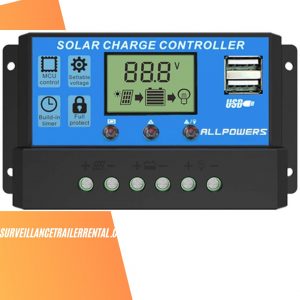
ALLPOWERS 20A Charge Controller
[/mks_one_third] [mks_two_thirds]
Key Features
- 3-stage charge and 4-stage PWM control.
- Multiple protection options.
- Small size ideal for RV, off-grid, or remote use.
Key Specifications:
- Two USB 5V, 3 amps ports.
- Charge current rated @ 20A.
- Battery Voltage 12/24V.
[/mks_two_thirds] [/mks_col]
The solar battery charger controller by ALLPOWERS is a good quality product that every solar enthusiast ought to consider.
The ALLPOWERS controller is a lead-acid battery charger that is capable of handling Flooded, AGM, or GEL cells. It is able to work at temperatures between -35 and 60 degrees Celsius. There are a variety of protection features to safeguard the circuit.
The power rate that can be adjusted with dual USB 5 volts, 3 amps ports, offers a great option for charging your phone or home appliances. The battery is fitted with an industrial-grade STM 8 microprocessor. It includes a three-stage (Bulk ABS, float, and float) charge management system, as well as the ability to charge in a 4-stage PWM. This ensures its longevity and safety.
Moreover, the easy-to-use LCD screen display clearly indicates the status and details of the system. It can easily switch between modes and offers an easy parameter configuration.
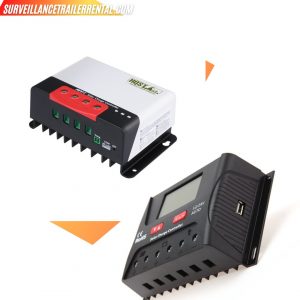
HQST 40 Charge Controller
[mks_col] [mks_one_third]
HQST 40 Solar Charge Controller
[/mks_one_third] [mks_two_thirds]
Key Features:
- Maximum PV input power 400W (12V), 800W (24V).
- Mode to control lighting appliances.
- Remote monitoring and control are possible.
Key Specifications:
- RJ12 communication port for RS232 protocol.
- Rated charge current of 30A.
- Battery Voltage 12/24V.
[/mks_two_thirds] [/mks_col]
High-Quality Solar Technologies (HQST) offers one of the top PWM models available. The HQST 40 is an intelligent and multifunctional solar charge controller with a dual USB port designed to work with modern electronics, and compatible with the HQST set of portable panels.
The microprocessor of the controller detects the 12- and 24-volt system voltages automatically. In addition, with the aid of temperature compensation, the charging parameters can be automatically adjusted.
It also has an LCD screen with keys for a human-machine interface. These keys allow you to select a range of working modes for the load which allows it to be used in various kinds of applications. To meet the specific requirements of the user, all charging and controlling parameters can be easily reset.
Many of the electrical protection options enhance the security of the entire system, safeguarding the battery’s life span of lead-acid and lithium batteries and safeguarding them from installation mistakes as well.
A communication option is available that provides the RJ12 data port (output of the TTL232 level or Bluetooth signals) with data using the standard Modbus protocol which can be used in conjunction with the monitoring software for computers, or mobile phone application.
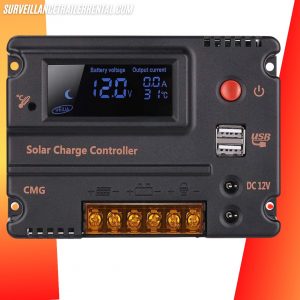
GHB 20A Charge Controller
[mks_col] [mks_one_third]
GHB 20A Charge controller
[/mks_one_third] [mks_two_thirds]
Key Features
- 12V automatic system recognition.
- PWM control to ensure system energy efficiency.
- Overload, short-circuiting, lightning, and under-voltage protection.
Key Specifications
- Two USB 5V, 3 amps ports.
- Charge current rated @ 20A.
- Battery Voltage 12/24V.
[/mks_two_thirds] [/mks_col]
GHB 20A is a solar charge controller for lead-acid batteries that offers a modern and clear LCD visualization screen.
This fully automatic charger can be used with any 12 volts system while offering many electrical protection options, including reverse polarity protection. The battery’s lifespan is increased by the PWM control, which improves system efficiency.
Its hardware comes with two USB 5 volts/3 amps ports, and a dual 12 volts output port to power DC lamps or works as a phone charger. The batteries can also be connected to temperature sensors for temperature compensation.
The enclosure is easy to install and allows easy setup and operation.
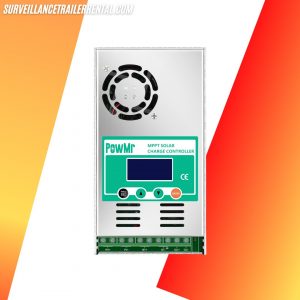
PowMr 60A Charge Controller
[mks_col] [mks_one_third]
PowMr 60A Charge Controller
[/mks_one_third] [mks_two_thirds]
Key Features:
- It operates at 12 and 24 volts.
- It is compact and perfect for RV, off-grid, or remote applications.
- Multiple protection options.
Key Specifications:
- Two USB 5V, 2-amps ports.
- Rated charge current of 20A.
- Voltage 12/24V Battery Voltage 12/24V.
[/mks_two_thirds] [/mks_col]
Sunix charger is another excellent PWM solar charge controller available because of its low cost.
PowMr 60A can handle up to 20 amps of charge and discharge current. It is compatible with 12- or 24-volt battery pack systems. It has an auto-switch function that determines the battery’s nominal voltage. The input charger can handle 50 volts or more of the working voltage generated by the solar array.
It is designed for small applications, however, it is a robust design that can provide over-load, short-circuit, lightning under-voltage, overload, and reverse polarity protection to batteries.
The LCD screen is able to show that the status of the system is visible to the user, and it’s simple to choose the charging mode and loading feeding mode.
How to Select the Best Solar Charge Controller
There are three things to consider when selecting a solar charge controller.
Battery Type and Voltage
First, you must determine whether the controller is able to charge your battery. Every battery requires a unique charging process. The stages of charging can differ from one stage to the next or differ in the way that the charge is executed at each stage in the first place.
It is important to confirm that the charger can handle the battery’s nominal voltage. The nominal voltages for standard commercial battery banks are 12, 24, and 48 volts.
Most controllers in a brand’s product line offer variations depending on the voltage of the battery that is being managed.
Solar Panel
The solar panel will serve as the life of your off-grid solar panel controller, therefore, it has to be able to communicate with the controller. To achieve this, the power and current capacity of the array cannot exceed the maximum input rating of the controller.
Budget
Are you struggling to make ends meet? Are your energy requirements minimal? A PWM controller would be the most suitable option. It is the best option for solar systems with small amounts of power that can protect and recharge your battery in a safe way.
An MPPT controller is a great option if you’re looking to maximize the power output of your solar array. They are typically used to charge a battery-powered system serving heating, cooling, and lighting appliances as they are designed to meet the higher energy requirements in order to maximize the power from your solar panels. These types of controllers are mainly used in residential, commercial, or industrial applications, but they are also used in smaller-scale applications.
Features to look for when buying a solar charge controller
Consider that the more features a charge controller have, the more expensive it would likely be.
There are myriad options today for charge controllers. Once you figure out the charging parameters that you require for your specific solar array and battery (generally available in the user manual or datasheet of the battery and solar panel), you can search for size, protection, or weight specifications.
Many people are concerned about the appearance of the controller once it is installed. There are flush, surface, and mounting options that could be the best option for you.
A key feature that could add value to the solar system is the ability to monitor and checking the balances of energy. Be sure to monitor the status of your system or access the register system details of your controller.
Number of Solar Panels that can be Connected to One Controller
Three factors influence the size of solar arrays to be used as charge controllers:
- Voltage of the open circuit (Voc): This is the maximum unloaded voltage that your solar array could generate. It should not exceed the maximum input voltage of the controller in any way.
- Maximum operating voltage (Vmp): This is the voltage that operates the solar arrays that generate the most wattage. It is recommended that Vmp be 12 or 24 volts higher than the nominal voltage of the battery.
- Maximum solar array power/current: Many controllers do not specify the maximum rated power, however, by making sure that the solar array is sized according to voltage and current limits on inputs, you can be sure that the controller will be able to handle the output power of your panels.
Many high-end controllers such as the MPPT controllers offer additional solar array power recommendations because they are able to handle higher Vmp voltages than the nominal voltage of the battery they are attached to. This is because of their ability to step down.
The number of solar panels that you are able to connect to your controller depends on the operating voltage and operating current, in addition to the open-circuit configuration of your array.
If your controller has the maximum power rating (250W) and you want to charge 12 Volt batteries, your solar array must have a Vmp that is close to 18-20 volts. It should also have the maximum current output of 14 amps (250W/18V = 13.88A) that should be within the controller’s current input capacity.
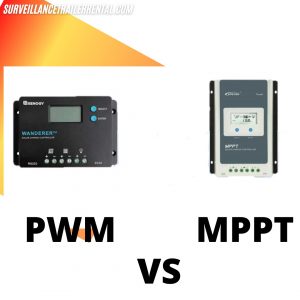
Difference between PWM and MPPT Solar Charge Controllers
PWM VS MPPT
A Pulse Width Modulation (PWM) charge controller is a type of switch between the panels of the battery and the panel.
- When the battery is in its lowest charge, the “switch” that connects the panels’ power source to the battery is in the ON position.
- The current flowing through the battery is under control when the battery reaches the desired voltage and it stabilizes. At this point, the controller “switches” in between ON and OFF to keep the battery’s voltage at the desired voltage.
- At the end of the charging process, the switch is OFF.
- Again, the switch switches between ON and OFF to maintain float voltage.
An MPPT is a multi-purpose power point. The controller is more like a “smart DC/DC” converter. It reduces the panel’s voltage to match the battery’s voltage while increasing the current that flows into the batteries at the same ratio to obtain an equivalent amount of power to the one generated by the solar modules at their highest power point. It examines the Maximum Power Point of operation (which varies throughout the day) and adjusts DC-DC converter output accordingly. So, the MPPT controller’s output power is much greater than the PWM option.
Understanding the Solar Charge Controller Ratings
To determine the charge controller model that you require to meet your specific needs you must know the datasheet of one of these devices. Depending on the brand you will see different ratings or parameters, but to size your solar system the most crucial factors you need to consider are:
- Nominal Voltage of the Battery System: It represents the nominal battery bank voltage. The set range is 12V/24V/48V/60V. Although some banks are more powerful than others.
- Maximum Continuous Output Current: This is the maximum amount of current the device can supply to charge the battery bank.
- Maximum Input Current: Based on the highest output from the solar panel array (short-circuit condition), which should be lower than the input limit of the charge controller.
- Operating Input Voltage: The voltages fluctuate throughout the day in accordance with the temperature variations. The controller must ensure that the voltage variations of the solar array are within the permitted limits.
- Maximum PV System Voltage: Maximum voltage even in the coldest conditions allowed for the solar array.
- Maximum Array STC Nameplate: Maximum STC power allowed in the solar system.
Lee Stauss
Recommended for you
Power [## What are the Best Batteries for an Off Grid Solar System?
2 years ago • 7 min read
For energy storage, solar batteries make a smart investment. You won’t have the ability to store the energy generated by your system in a bank for later use. A battery bank is essential if you are tied to the grid. Without it, there will be no backup power in](/temp-slug-71/)

Power [## Discover the Key to Perfectly Sizing Your Solar-Powered Surveillance Trailer System
2 years ago • 6 min read
Learn how to perfectly size your solar-powered surveillance trailer system by understanding power needs, choosing the right solar panels, selecting the best batteries, and ensuring proper wiring and safety. Discover key tips and essential components for an efficient and reliable setup.](/discover-the-key-to-perfectly-sizing-your-solar-powered-surveillance-trailer-system/)
In Progress [## Top 5: Best MPPT Charge Controllers for Solar Power
4 years ago • 11 min read
Top 5: Best MPPT Charge Controllers for Solar Power As a solar enthusiast, you are aware that adding an MPPT Charge Controller to your system is an efficient way to protect your battery and also boost the power produced by your surveillance trailer or other off grid system. Of course,](/the-best-mppt-solar-chargers/)